Is Your First Step Out of Bed a Sharp Pain?
If you wake up and dread that first step on the floor, you aren't alone. Plantar fasciitis is one of the most common causes of heel pain — and for many in Okotoks, it feels like a condition that simply won't go away.
Stretching helps temporarily. New shoes help temporarily. Rest helps temporarily. But chronic plantar fasciitis isn't just inflamed tissue anymore — it's degenerated tissue, and that requires a fundamentally different approach to heal.
That is where focused shockwave therapy in Okotoks delivers measurable results. By stimulating tissue repair at the cellular level, this non-invasive modality addresses stubborn heel pain directly.
For a complete clinical guide to plantar fasciitis — including causes, symptoms, and our full treatment approach — see our Plantar Fasciitis condition page.
Why Chronic Heel Pain Stops Responding to Traditional Treatment
When plantar fasciitis first develops, it is genuinely inflammatory — and anti-inflammatories, ice, and rest help because they address that inflammation. But when heel pain persists beyond 3 months, something shifts.
The tissue transitions from an inflammatory state to a degenerative state — the collagen fibers that make up the plantar fascia become disorganized, the local blood supply diminishes, and the body essentially stops sending healing resources to the area. At this point, the condition is more accurately called plantar fasciosis, and treatments that worked early on stop working because they're addressing inflammation that is no longer the primary problem.
This is why chronic plantar fasciitis is so stubborn — and why shockwave therapy works when other treatments have failed.
What Is Shockwave Therapy?
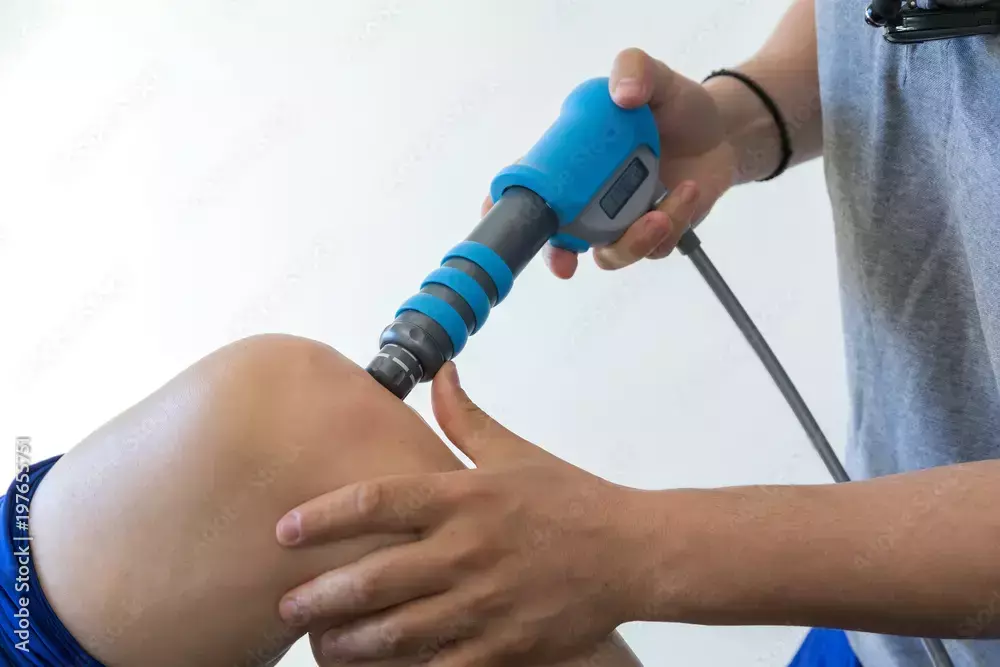
Despite the name, there are no electric shocks involved. Shockwave therapy uses high-energy acoustic (sound) waves delivered through a handheld device to penetrate deep into the damaged tissue.
These waves create a controlled "micro-trauma" at the site of the injury, triggering three vital healing responses:
1. Neovascularization — new blood vessel formation The acoustic waves signal your body to grow new blood vessels into the degenerated tissue. This restores the nutrient and oxygen supply that chronic injuries lose — essentially reopening the door to healing that had closed.
2. Breaking the pain cycle Shockwave desensitizes local nerve fibers, reducing the pain signals transmitted from the heel to the brain. Many patients notice a significant reduction in "first step" morning pain within 2–3 sessions.
3. Restarting collagen production The micro-trauma triggers your body to produce new, organized collagen — the structural protein that gives the plantar fascia its tensile strength. This is the repair mechanism that chronic injuries have lost.
In short: shockwave doesn't mask the pain. It restarts the biological process that actually heals the tissue.
What Does the Research Show?
Shockwave therapy for plantar fasciitis is one of the most well-researched non-invasive treatments in musculoskeletal physiotherapy. Multiple clinical trials show:
- Success rates of 80–90% for chronic cases that haven't responded to conventional treatment
- Significant reduction in pain scores after 3–5 sessions
- Durable results at 12-month follow-up, with most patients maintaining their improvement
- Outcomes comparable or superior to cortisone injection — without the tissue-weakening side effects of repeated steroid use
Dynamic Physiotherapy: Alberta's First Shockwave Provider
When shockwave therapy was producing remarkable results in Europe but was still unavailable in Alberta, Dynamic Physiotherapy invested in the technology and became the first clinic in the province to offer it.
In those early years, our clinic director Steve Hansen traveled across Alberta — working with physicians, podiatrists, and their patients — because access to this treatment was so limited. People drove hours for sessions because they'd tried everything else.
hat background ensures your care is managed by registered clinicians who understand tissue loading, frequency thresholds, and anatomical targeting. We integrate acoustic therapy into a broader framework of physiotherapy in Okotoks, ensuring the surrounding calves, hips, and foot mechanics are treated together.
Am I a Candidate for Shockwave?
Shockwave therapy for plantar fasciitis works best when:
- Your heel pain has persisted for 3 months or longer
- You've tried stretching, orthotics, or other conservative treatments without lasting relief
- Cortisone injections provided only temporary relief or you want to avoid them
- You want to avoid surgery
It may not be appropriate if you have:
- Active infection or open wounds in the treatment area
- Blood clotting disorders or are on blood thinners
- Pregnancy
- Certain neurological conditions affecting the foot
Your physiotherapist will assess your suitability during your initial consultation.
What to Expect During Your Sessions
Treatment is straightforward and takes about 10–15 minutes per session:
- Gel is applied to the heel to help conduct the acoustic waves
- A handheld device delivers rapid pulses to the affected area
- You'll feel a firm tapping or pulsing sensation — intensity is always adjusted to your comfort level
- The most tender spots may feel more intense, but this typically decreases as the session progresses
Most patients complete 3–5 sessions spaced one week apart. Many notice a meaningful reduction in morning stiffness and first-step pain after sessions 2 or 3.
At Dynamic Physiotherapy, shockwave is never used in isolation. We pair every course of treatment with a targeted foot strengthening and loading program to ensure your heel stays healthy for the long term — and doesn't come back.
Beyond Plantar Fasciitis: Other Conditions We Treat With Shockwave
Shockwave therapy is highly effective across a range of stubborn tendon and soft tissue conditions. If you or someone you know is dealing with any of the following, the same technology applies:
- Achilles tendinopathy — chronic heel cord pain that hasn't responded to stretching or rest
- Tennis and golfer's elbow — lateral or medial epicondylitis that has become chronic
- Hip bursitis and lateral hip pain — gluteal tendinopathy and greater trochanteric pain syndrome
- Knee pain — patellar tendinopathy (jumper's knee) and secondary tendon issues around the knee
- Shoulder pain — calcific tendinitis and chronic rotator cuff tendinopathy
Ready to Stop Managing the Pain and Start Healing It?
If you've been "managing" heel pain for months with stretches and supportive shoes but aren't getting better, it may be time for a treatment that addresses the actual biology of what's happening in your tissue.
Our Okotoks team has been delivering shockwave therapy longer than anyone else in Alberta. We know what works, and we'll build a plan around your specific presentation — not a generic protocol.

Steve Hansen
Contact Me